
How Do We Assess the Baby’s Progress Through the Pelvis?

Written by Dr. Specialist Stine Andreasen
Specialist in Gynecology and Obstetrics, PhD in Obstetrics in 2015 and more than 15 years of clinical practice in Obstetrics and Gynecology
During labour, healthcare professionals assess not only how much the cervix has opened, but also how far the baby’s head has moved down through the pelvis. This is called fetal head station.
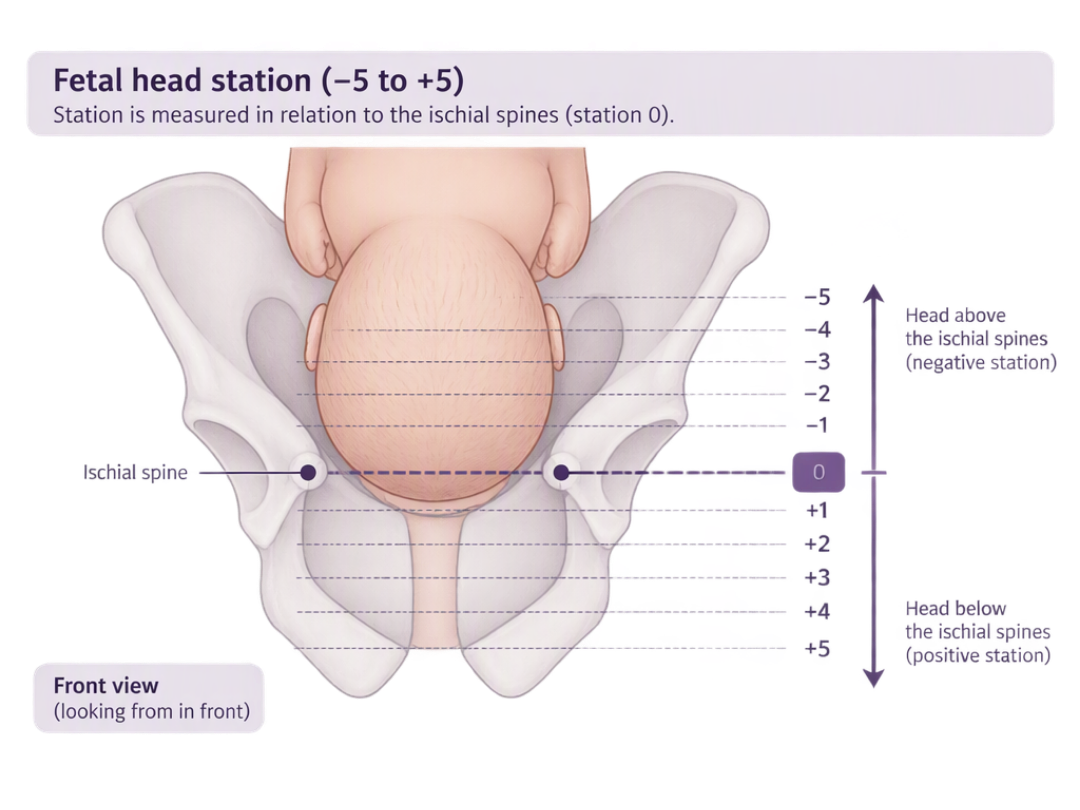
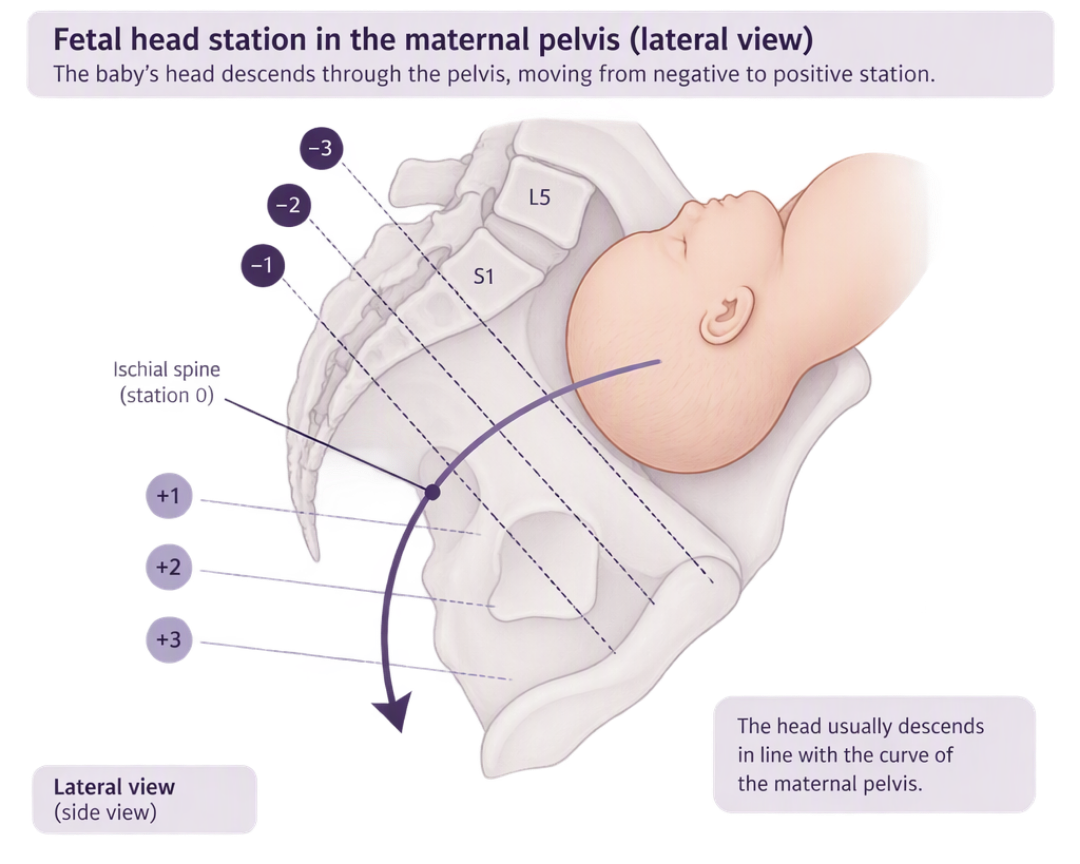
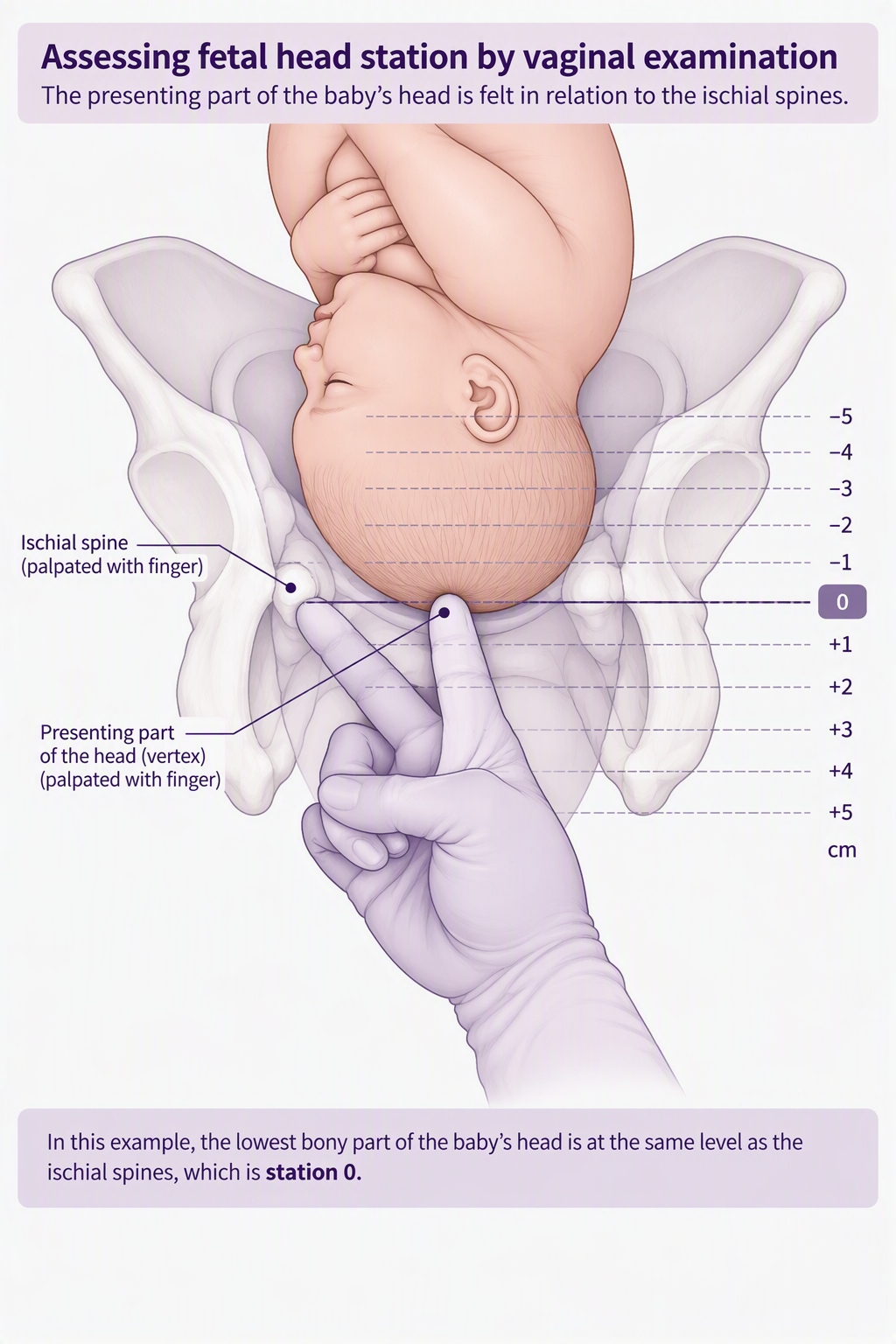
Station is assessed in relation to two small bony landmarks in the mother's pelvis called the ischial spines. These provide a fixed reference point that can be felt during a vaginal examination. When the lowest bony part of the baby's head is level with the ischial spines, this is called station 0. A negative station means that the head is still above the spines, while a positive station means that it has moved below them and further down the birth canal.
Different Ways of Describing Station
There are different systems for describing how far the baby's head has descended.
The five stations system
In the −5 to +5 system, station is described in approximately one-centimetre steps:
−5 to −1: The baby's head is above the ischial spines.
0: The baby's head is level with the ischial spines.
+1 to +5: The baby's head has moved below the ischial spines and towards the vaginal opening.
The three stations system
Another commonly used system describes station from −3 to +3. In this system, the pelvis above and below the ischial spines is divided into fewer levels:
−3 to −1: The baby's head is above the ischial spines.
0: The baby's head is level with the ischial spines.
+1 to +3: The baby's head has descended below the ischial spines towards the pelvic outlet.
“Because different hospitals and healthcare professionals may use different systems, the number used to describe station can vary. The important information is whether the baby’s head is moving progressively down through the pelvis. ”
How Is Fetal Head Station Assessed?
Station is usually assessed during a vaginal examination. The midwife or doctor feels for the ischial spines and assesses the position of the baby's head in relation to them.
The examination can also provide information about:
How much the cervix has opened (cervical dilation)
How thin and shortened the cervix has become
The position and rotation of the baby's head
How far the head has descended
In some situations, ultrasound during labour may also be used to provide additional information about the position and descent of the baby's head.
As labour progresses, the baby's head normally moves gradually down through the pelvis. Healthcare professionals assess this together with cervical dilation, contractions, the baby's position, and the wellbeing of both mother and baby.
Progress is not always constant. The baby's head may remain at the same level for some time before descending further, particularly during the first stage of labour.
If the baby's head does not descend as expected, the healthcare team will consider the overall situation. Possible reasons may include the baby's position, the strength and frequency of contractions, or how the baby's head fits through the maternal pelvis.
Station and the Second Stage of Labour
During the second stage of labour, after the cervix is fully dilated, the baby normally moves further down through the birth canal with contractions and pushing.
The baby's station and position become particularly important if assistance with birth is being considered. Before a vacuum or forceps delivery, the healthcare professional must know the position of the baby's head and assess that it has descended sufficiently for an assisted vaginal birth to be performed safely.
Station Is Only One Part of Assessing Labour
There is no single measurement that tells healthcare professionals whether labour is progressing normally.
Fetal head station is therefore always considered together with other findings, including:
Cervical dilation
Changes in the cervix over time
Strength and frequency of contractions
Position and rotation of the baby's head
Fetal heart rate
The mother's wellbeing
Together, these observations provide a more complete picture of how labour is progressing and whether mother and baby are doing well.
FAQ – Fetal head station
-
It describes how far the baby’s head has moved down through the pelvis during labour. Alongside cervical dilation, it’s one of the ways healthcare professionals follow how labour is progressing.
-
Station is described relative to the ischial spines, two bony points in the pelvis. When the baby’s head is level with them, the station is 0. Negative numbers mean the head is still above the spines, and positive numbers mean it has moved below them, towards the vaginal opening.
-
Two systems are commonly used. One runs from −5 to +5 in roughly one-centimetre steps. The other runs from −3 to +3 and divides the pelvis into fewer levels. Hospitals and professionals may use either, so the same position can be described with different numbers. What matters most is whether the head is moving progressively downward.
-
Usually through a vaginal examination, where the midwife or doctor feels for the ischial spines and assesses where the baby’s head sits in relation to them. In some situations, ultrasound during labour can add information about the position and descent of the head.
-
Besides station, it gives information about how much the cervix has opened, how thin and shortened it has become, and the position and rotation of the baby’s head.
-
Not always. The head normally descends gradually, but it can stay at the same level for a while before moving further, particularly during the first stage of labour.
-
The healthcare team looks at the overall situation. Possible reasons include the baby’s position, the strength and frequency of contractions, or how the baby’s head fits through the pelvis.
-
Once the cervix is fully dilated, the baby normally moves further down the birth canal with contractions and pushing. If a vacuum or forceps delivery is being considered, the professional must know the position of the baby’s head and confirm it has descended far enough for an assisted vaginal birth to be performed safely.
-
No. There’s no single measurement that answers that. Station is always considered together with cervical dilation, changes in the cervix over time, the strength and frequency of contractions, the position and rotation of the baby’s head, the fetal heart rate, and the mother’s wellbeing.